|
|

Smithsonian Institution: John P. Harrington Papers
                                                               
John Peabody Harrington's card files (organized field notes) from his series of interviews with the Kitanemuk informant Eugenia Mendez in October 1916. Shown here are the card files relating to Eugenia's discussions of people. (Her memories of places, ceremonies, games, flora, fauna and other topics appear in other files.) Attribution: Southern California/Basin: Kitanemuk, John Peabody Harrington papers, National Anthropological Archives, Smithsonian Institution. Vol. 3, Reel 100, files 186-246. Background: Following three weeks in Los Angeles in October 1916, Harrington (accompanied by his wife, Carobeth) continued field work in an area which encompassed Kitanemuk, Tataviam, Yokuts, and some inland Chumash groups. Due to intermarriage, removal, containment, and trade, many of these people knew terms in several dialects. Among the principal informants were Eugenia Mendez of Tejon; her niece, Magdalena Olivas; and Magdalena's husband, Jose Juan Olivas, who was born at Saticoy, came to Tejon at age 12 and, according to Harrington's reports, was an "inland Chumash speaker." Angela Montes, Juan and Angela Lozada, Sebastiana Higinio, Jim Monte, and Josefa Cordero also contributed data. Monte and Cordero were of Yokuts parentage. Magdalena Olivas was Angela Lozada's aunt and, according to Lozada, both women also spoke Tubatulabal. Note: Harrington variously refers to Kitanemuk as Jam., Jaminote, Jarminot and Haminot. He uses "V." apparently to denote Ventureno Chumash. Harrington's notes alternate among English, Spanish and Kitanemuk, and he uses the German word "geschwister" in place of "siblings." There are also terms in Tubatulabal, Serrano, Fernandeno(?), Gabrielino (Tongva?), Mohave and Tataviam. The informant is (often) identified in the upper right-hand corner as "Eug..." or similar.
Southern California/Basin: Kitanemuk, John Peabody Harrington papers, National Anthropological Archives, Smithsonian Institution. From Vol. 3, Reel 100. |
• Tataviam Ethnohistory Johnson & Earle 1990 • The Indians of Mission San Fernando (Johnson 1997) 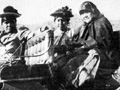
Sinforosa Fustero ~1910
|
The site owner makes no assertions as to ownership of any original copyrights to digitized images. However, these images are intended for Personal or Research use only. Any other kind of use, including but not limited to commercial or scholarly publication in any medium or format, public exhibition, or use online or in a web site, may be subject to additional restrictions including but not limited to the copyrights held by parties other than the site owner. USERS ARE SOLELY RESPONSIBLE for determining the existence of such rights and for obtaining any permissions and/or paying associated fees necessary for the proposed use.
