


Page 55 - califmining1923
P. 55
STATISTICS OF ANNUAL     PRODUCTION.                  53

                      The following paragraph is quoted from the U. S. Geological Survey,
                    Advance Chapter on 1923, by courtesy of Mr. J. M. Hill, statistician in
                    charge of the San Francisco branch office :
                      "Of the  total  silver  output  of California in  1923 the  44  properties  producing
                    over 1,000 ounces  contributed  99.16 per cent.  At  22 properties  between  1,000 and
                    5,000 ounces were produced,  at 11 mines between  5,000 and 10,000 ounces,  at 7 mines
                    between  10,000 and 50,000 ounces, at 4 mines between  100,000 and 200,00 ounces, and
                    at only  1 property  (California Rand  Silver, Inc.) was more than  2,500,000  ounces
                   produced.  Of the mines with an output of over 100,000 ounces  2 were lead mines in
                    Inyo County and  2 were copper  mines in Plumas  County.  San Bernardino  County
                   held first rank in silver production, followed by Inyo, Plumas,  and Shasta counties.
                    The 10 largest silver producers in the state,  named  in order of rank, were California
                   Rand Silver, Inc. (Ag.), Engels Copper Co. (Cu.), Walker Mining  Co. (Cu.), Darwin
                    Silver Co. (Pb.), Tecopa Consolidated Mg. Co. (Pb.), Zenda Mg. Co. (Ag.), Mammoth
                    Copper Co. (Cu.), Cerro Gordo Mines Co. (Pb), Empire  Mines Co. (Au.), Mountain
                    Copper Co. (Cu.).
                      "The increase in the quantity  of silver produced in California in 1923 was  due
                   largely  to the increased shipments from  the Rand  silver mines, in San  Bernardino
                    County, and  the lead ores produced in Inyo County, though the Zenda mine, in the
                   Amelia  district, Kern County,  made  a considerable  increase.  Notable  increases in
                   silver production were also made  in Nevada, Orange, Shasta, and Trinity counties.
                      "The output of silver from  placer mines in  1923 was  20,305  ounces,  valued at
                    $16,650, an increase of 4 per cent in quantity and a decrease  of 15 per cept in value,
                   as compared with  1922.  Dredges saved  6 per cent more and surface mines  63 per
                   cent more silver than in 1922, but the drift arid hydraulic  mines each  made  31 per
                   cent less silver than in 1922.
                      "The production of silver from  deep mines in 1923 was 3,539,138  ounces,  valued
                    at $2,902,093, an increase of 15 per cent  in quantity but a decrease  of 6 per cent in
                   value, as compared with 1922.  The Kelly mine, of the California Rand Silver, Inc., at
                    Randsburg,  was by far the largest producer of silver in the  state.  Lead  ores from
                   Inyo County  gave  the second  largest output of silver, and copper ore from Plumas
                   County  the third  largest contribution  to the total silver output in 1923.  Dry gold
                   ores  gave  2.31  per cent,  silver  ores  77.34 per cent,  copper ores  9.59 per cent,  and
                   lead  ores  9.28 per cent of the total silver yield.  The recovery of silver at gold and
                   silver mills in 1923  was  4 per cent, and smelters recovered  96 per cent of the total.
                   Concentrates carried  72 per cent, and ore sent direct to smelters  24 per cent of the
                   total silver produced at deep mines."
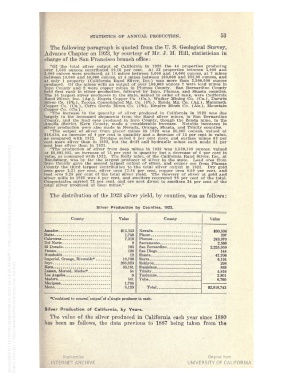
                      The distribution of the ,1923 silver yield, by counties, was as follows :
                                         Silver  Production  1 ay Counties,  1923.

                               Cotmty              Value             County              Value


                    Amador                          $15,153  Nevada                       $30,534
                   Butte.                            1,756  Placer                           297
                   Calaveras                         7,316  Plumas                        243,970
                    Del Norte                           9  Sacramento                       2,566
                    El Dorado.. _                     185                                2,225,959
                    Fresno                             128                                   144
                    Humboldt                           12  Shasta                          47,706
                    Imperial, Orange,  Riverside*   16,736  Sierra  .                       6,134
                    Inyo.                          265,023  Siskiyou                         298
                    Kern                            33,151                                   833
                    Lassen, Merced, Modoc*             54  Trinity                          5,816
                    Los Angeles         . .             6  Tuolumne                         2.801
                    Madera                            541  Yuba                             6,760
                                                     1,735
                    Mono                             3.120    Total.                    $2,918,743

                      ♦Combined  to concearoutput'of a'single producer in each.

                    Silver Production of California,  by Years.
                      The value of the silver produced in California each year since 1880
                    has been as follows, the data previous to 1887 being taken from the

