


Page 16 - hb1713_2
P. 16
R.L.W.

     Pioneer Oil Refinery: California Star Oil Works                                                kit #RLW-1680

     STORAGE TANKS

        The storage tanks currently on the hillside above the stills are reported to not be
        from  the  period  of  significance.  The  historic  record  varies  from  vague  to
        contradictory in its description of the crude oil storage tanks on site during the
        refinery’s  operations.  Early  accounts  state  the  oil  storage  tanks  capacity  at  20
        and 100 barrels were on the hillside above the stills; another source states these
        were 50 barrel tanks. Probably the tanks were replaced and upgrade more than
        once during the active use of the site, either as a refinery in the early years or as
        a transfer point from storage from the Pico Canyon oil field output to loading to
        tank cars. Additional to the crude oil storage tanks, there was apparently a water
        storage tank from which the pump house drew its supply which was pumped the
        600 feet up and seven miles to the Pico Canyon field.

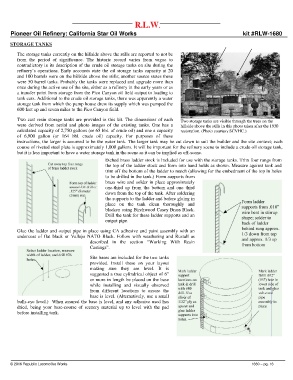
        Two cast resin storage tanks are provided in this kit. The dimensions of each   Two storage tanks are visible through the trees on the
        were  derived  from  aerial  and  photo  images  of  the  existing  tanks.  One  has  a   hillside above the stills in this photo taken after the 1930
        calculated capacity of 2,750 gallons (or 65 bbl. of crude oil) and one a capacity   restoration. (Photo courtesy SCVHC.)
        of  6,900  gallon  (or  164  bbl.  crude  oil)  capacity.  For  purposes  of  these
        instructions, the larger is assumed to be the water tank. The larger tank may be cut down to suit the builder and the site context; each
        course of riveted steel plate is approximately 1,000 gallons. It will be important for the refinery scene to include a crude oil storage tank,
        but it is less important to have a water storage tank in the scene as it can be implied as off-scene.
                                             Etched brass ladder stock is included for use with the storage tanks. Trim four rungs from
                                             the top of the ladder stock and form into hand holds as shown. Measure against tank and
                                             trim off the bottom of the ladder to match (allowing for the embedment of the top in holes
                                             to be drilled in the tank.) Form supports from
                                             brass wire and solder in place approximately
                                             one-third  up  from  the  bottom  and  one  third
                                             down from the top of the tank. After soldering
                                             the supports to the ladder and before gluing in
                                             place  on  the  tank  clean  thoroughly  and
                                             blacken using Birchwood Casey Brass Black.
                                             Drill the tank for these ladder supports and an
                                             output pipe.

        Glue the ladder and output pipe in place using CA adhesive and paint assembly  with an
        undercoat  of  flat  black  or  Vallejo  NATO  Black.  Follow  with  weathering  and  Rustall  as
                                       described  in  the  section  “Working  With  Resin
                                       Castings”.

                                       Site bases are included for the two tanks
                                       provided.  Install  these  on  your  layout
                                       making  sure  they  are  level.  It  is
                                       suggested a true cylindrical object of 6”
                                       or more in length be placed on the base
                                       while  installing  and  visually  observed
                                       from  different  locations  to  assure  the

                                       base is level. (Alternatively, use a small
        bulls-eye level.)  When assured the base is level, and any adhesive used has
        dried,  being  your  base-course  of  scenery  material  up  to  level  with  the  pad
        before installing tank.


     © 2016 Republic Locomotive Works                                                                      1680 – pg. 16

