


Page 28 - scvhs_docenttrainingmanual2006
P. 28
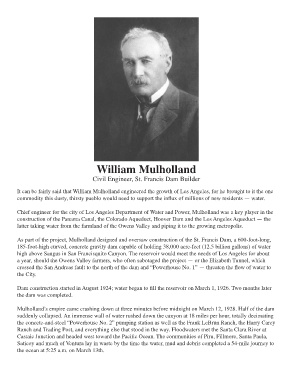
William Mulholland

                                        Civil Engineer, St. Francis Dam Builder

        It can be fairly said that William Mulholland engineered the growth of Los Angeles, for he brought to it the one
        commodity this dusty, thirsty pueblo would need to support the influx of millions of new residents — water.


        Chief engineer for the city of Los Angeles Department of Water and Power, Mulholland was a key player in the
        construction of the Panama Canal, the Colorado Aqueduct, Hoover Dam and the Los Angeles Aqueduct — the
        latter taking water from the farmland of the Owens Valley and piping it to the growing metropolis.


        As part of the project, Mulholland designed and oversaw construction of the St. Francis Dam, a 600-foot-long,
        185-foot-high curved, concrete gravity dam capable of holding 38,000 acre-feet (12.5 billion gallons) of water
        high above Saugus in San Francisquito Canyon. The reservoir would meet the needs of Los Angeles for about
        a year, should the Owens Valley farmers, who often sabotaged the project — or the Elizabeth Tunnel, which
        crossed the San Andreas fault to the north of the dam and “Powerhouse No. 1” — threaten the flow of water to
        the City.

        Dam construction started in August 1924; water began to fill the reservoir on March 1, 1926. Two months later
        the dam was completed.


        Mulholland’s empire came crashing down at three minutes before midnight on March 12, 1928. Half of the dam
        suddenly collapsed. An immense wall of water rushed down the canyon at 18 miles per hour, totally decimating
        the concete-and-steel “Powerhouse No. 2” pumping station as well as the Frank LeBrun Ranch, the Harry Carey
        Ranch and Trading Post, and everything else that stood in the way. Floodwaters met the Santa Clara River at
        Castaic Junction and headed west toward the Pacific Ocean. The communities of Piru, Fillmore, Santa Paula,
        Saticoy and much of Ventura lay in waste by the time the water, mud and debris completed a 54-mile journey to
        the ocean at 5:25 a.m. on March 13th.

