


Page 565 - trc_centennial_deir201705
P. 565
5.4 Water Quality

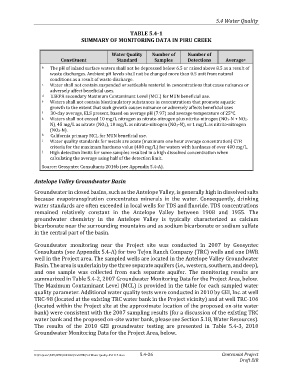
                                                       TABLE 5.4-1
                                   SUMMARY OF MONITORING DATA IN PIRU CREEK

                                                Water Quality    Number of      Number of
                          Constituent             Standard        Samples      Detections      Average
                                                                                                       a
                   b    The pH of inland surface waters shall not be depressed below 6.5 or raised above 8.5 as a result of
                      waste discharges. Ambient pH levels shall not be changed more than 0.5 unit from natural
                      conditions as a result of waste discharge.
                   c    Water shall not contain suspended or settleable material in concentrations that cause nuisance or
                      adversely affect beneficial uses.
                   d    USEPA secondary Maximum Contaminant Level (MCL) for MUN beneficial use.
                   e    Waters shall not contain biostimulatory substances in concentrations that promote aquatic
                      growth to the extent that such growth causes nuisance or adversely affects beneficial uses
                   f    30-day average, ELS present, based on average pH (7.97) and average temperature of 25°C.
                   g    Waters shall not exceed 10 mg/L nitrogen as nitrate-nitrogen plus nitrite-nitrogen (NO3-N + NO2-
                      N), 45 mg/L as nitrate (NO3), 10 mg/L as nitrate-nitrogen (NO3-N), or 1 mg/L as nitrite-nitrogen
                      (NO2-N).
                   h    California primary MCL for MUN beneficial use.
                   i    Water quality standards for metals are acute (maximum one hour average concentration) CTR
                      criteria for the maximum hardness value (400 mg/L) for waters with hardness of over 400 mg/L.
                   j     High detection limits for some samples resulted in a high dissolved concentration when
                      calculating the average using half of the detection limit.

                   Source: Geosyntec Consultants 2016b (see Appendix 5.4-A).

               Antelope Valley Groundwater Basin

               Groundwater in closed basins, such as the Antelope Valley, is generally high in dissolved salts
               because  evapotranspiration  concentrates  minerals  in  the  water.  Consequently,  drinking
               water standards are often exceeded in local wells for TDS and fluoride. TDS concentrations
               remained  relatively  constant  in  the  Antelope  Valley  between  1908  and  1955.  The
               groundwater  chemistry  in  the  Antelope  Valley  is  typically  characterized  as  calcium
               bicarbonate near the surrounding mountains and as sodium bicarbonate or sodium sulfate
               in the central part of the basin.

               Groundwater  monitoring  near  the  Project  site  was  conducted  in  2007  by  Geosyntec
               Consultants (see Appendix 5.4-A) for two Tejon Ranch Company (TRC) wells and one DWR
               well in the Project area. The sampled wells are located in the Antelope Valley Groundwater
               Basin. The area is underlain by the three separate aquifers (i.e., western, southern, and deep),
               and  one  sample was collected from  each separate  aquifer. The monitoring  results  are
               summarized in Table 5.4-2, 2007 Groundwater Monitoring Data for the Project Area, below.
               The Maximum Contaminant Level (MCL) is provided in the table for each sampled water
               quality parameter. Additional water quality tests were conducted in 2010 by GEI, Inc. at well
               TRC-98 (located at the existing TRC water bank in the Project vicinity) and at well TRC-106
               (located within the Project site at the approximate location of the proposed on-site water
               bank) were consistent with the 2007 sampling results (for a discussion of the existing TRC
               water bank and the proposed on-site water bank, please see Section 5.18, Water Resources).
               The  results  of  the  2010  GEI  groundwater  testing  are  presented  in  Table  5.4-3,  2010
               Groundwater Monitoring Data for the Project Area, below.


               R:\Projects\PAS\CEN\000306\Draft EIR\5.4 Water Quality-051117.docx   5.4-26    Centennial Project
                                                                                                     Draft EIR

