


Page 354 - us_mineralresources1885
P. 354
:

              338                         MINERAL RESOURCES.

                The ash fioiii the calm is, of course, left iu the residuum, mtikiug it
              leaner and adding a most objectionable amount of silica and alumina.
                The clinker, as it comes from the oxide furnaces, is partly in flat cakes,
              about 2 inches thick and from 4 to 10 inches in diameter, and partly              in
              small fragments, from dust to 2 inches in diameter.             It is screened be
              fore going to the blastfurnaces, the very fine portion being rejected.
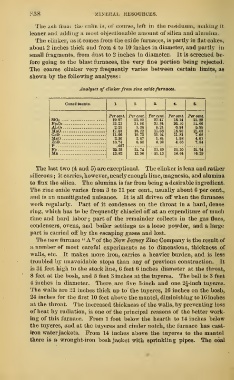
              The coarse clinker very frequently varies between certain limits, as
              shown by the following analyses


                                   Analyses of clinker from zinc oxide furnaces.


                             Constituents.                                   4.


                                                Per cent.  Per cent.  Per cent.  Per cent.  Percent.
                       SiOs  .                    19.97    25.03    23. 47   18.14   21.29
                       FesOs                      33.21    31.06    33.84    36.16   31.06
                       AI2O3                       2.25     6.36     8.24    6.94     5.98
                       MnO.                       17.83    16.22    15.66    18.90   21.03
                       CaO  .                     11.96    10.73    11.04    11.81    7.60
                       MgO.                        2.30     2.67     1.84    1.98     4.01
                       ZnO..                      10.74     6.98     4.98    4.06     7.84
                       P ....                       .037
                       re...                      23.25    21.74    23.69    25.30   21.74
                       Mn ..                      13.82    12.56    12.13    14.64   16.29


                 The last two (4 and 5) are exceptional.        The clinker is lean and rather
                          it carries, however, nearly enough lime, magnesia, and alumina
              siliceous ;
              to flux the silica.    The alumina is far from being a desirable ingredient.
              The zinc oxide varies from 3 to 11 per cent., usually about 6 per cent.,
              and is an unmitigated nuisance.          It is all driven off when the furnaces
              work regularly.      Part of it condenses on the throat in a hard, dense
              ring, which has to be frequently chiseled off at an expenditure of much
              time and hard labor        part of the remainder collects in the gas flues,
                                       ;
              condensers, ovens, and boiler settings as a loose powdea", and a large
              part is carried off by the escaping gases and lost.
                 The new furnace " A " of the ISTew Jersey Zinc Company is the result of
              a number of most careful experiments as to dimensions, thickness of
              walls, etc.    It makes more iron, carries a heavier burden, and is less
              troubled by unavoidable stops than any of previous construction.                   It
              is 31 feet high to the stock line, 6 feet 6 inches diameter at the throat,
              8 feet at the bosh, and 5 feet 3 inches at the tuyeres.          The bell is 3 feet
              4 inches in diameter.        There. are five 3-inch and one 2^-inch tuyeres.
              The walls are ;il inches thick up to the tuyeres, 16 inches on the bosh,
              24 inches for the first 10 feet above the mantel, diminishing to IG inches
              at the throat.     The increased thickness of the walls, by preventing loss
              of heat by radiation, is one of the principal reasons of the better work-
              ing of this furnace.      From 1 foot below the hearth to 14 inches below
              the tuyeres, and at the tuyeres and cinder notch, the furnace has cast-
              iron water jackets.     Prom 14 inches above the tuyeres to the mantel
              there is a wrought-iron bosh jacket with sprinkling pipes.                The coal

