


Page 78 - califmining1923
P. 78
'6                 MINERAL   INDUSTRY   OF CALIFORNIA.

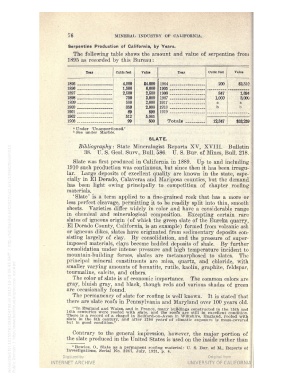
                              Serpentine  Production of California,  by Years.
                                The following table shows the amount     and value of serpentine from
                             1895  as recorded  by this Bureau:

                                     Tear        Cubic feet  Value         Year         Cubic feet  Value


                             1895                   4.000    $4,000  1904                   200      $2,310
                             1896                   1,500     6,000  1905
                             1897                   2,500     2,500  1906  - _              847      1.694
                             1898                     750     3,000  1907                  1,000     3.00O
                             1899 _„     _            500     2,000  1917                  a         a
                             1900                     350     2.000  1918                  b         b
                             1901                     89       890  1919    -
                             1902                    612      5,065
                             1903                     99       800     Totals             12,347    $33,259
                                "  Under  'Unapportioned.
                                ^See under Marble.
                                                               SLATE.
                                  Bibliography  : State Mineralogist   Reports XV, XVIII.       Bulletin
                                '
                                    38.   U. S. Geol. Surv., Bull. 586.  U. S. Bur. of Mines, Bull. 218.
                               Slate was first produced in California in 1889.     Up to and including
                             1910 such production was continuous, but since then it has been irregu-
                             lar.  Large deposits of excellent quality are known in the state, espe-
                             cially in El Dorado, Calaveras and Mariposa counties, but the demand
                             has been light owing principally to competition of chapter roofing
                             materials.
                               'Slate' is a term applied to a fine-grained rock that has a more or
                             less perfect cleavage, permitting it to be readily split into thin, smooth
                             sheets.  Varieties differ widely in color and have a considerable     range
                             in chemical   and mineralogical    composition.   Excepting    certain rare
                             slates of igneous origin  (of which the green slate of the Eureka quarry,
                             El Dorado County, California,    is an example)  formed from volcanic ash
                             or igneous dikes, slates have originated from sedimentary deposits con-
                             sisting largely of clay.   By consolidation, and the pressure of super-
                             imposed materials, clays become bedded deposits of shale.       By further
                             consolidation under intense pressure and high temperature incident to
                             mountain-building    forces,  shales  are metamorphosed     to  slates.  The
                             principal mineral constituents are     mica,  quartz,  and chloride, with
                             smaller varying amounts of hematite, rutile, kaolin, graphite, feldspar,
                             tourmaline, calcite,  and others.
                               The color of slate is of economic importance.     The common colors are
                             gray, bluish gray, and black, though reds and various shades of green
                             are occasionally found.
                               The permanency of slate for roofing is well known.       It is stated that
                             there are slate roofs in Pennsylvania   and Maryland    over 100 years old.
                               I'ln England and Wales, and in France, many buildings constructed in the 15th and
                             16th centuries were roofed with  slate,  and the roofs are still in excellent condition.
                             There is a record of a chapel in Bedford-on-Avon  in Wiltshire,  England,  roofed with
                             slate  in the  8th century, and after  1200 year^ of climatic exposure is moss-covered
                             but m good condition."
                               Contrary   to the general  impression,  however,   the major portion of
                             the slate produced in the United States is used on the inside rather than
                               ^ Bowles, O., Slate as a permanent roofing material : U.
                             Investigations,  Serial No. 2267, July,  1921, p.  4.  S. Bur. of M., Reports of

