


Page 81 - califmining1923
P. 81
STATISTICS OF ANNUAL     PRODUCTION.                   79

                     Grinding Mill Pebbles.
                        Production   of pebbles for tube and grinding      mills began  commer-
                     cially in California in    1915.   Owing   to the  decreased   iniports  and
                     higher prices of Belgium and other European flint pebbles, due to the
                     war, there was a serious inquiry for domestic sources of supply.     One of
                     the shipments   made in that year was of pebbles       selected from gold-
                     dredger tailings   in Sacramento County, for use in         a gold mill in
                     Amador County emplwing Hardinge           mills.
                        The important development     in this item, however,  took place in San
                     Diego County.     At several points along the ocean shore from Encinitas
                     south to near San Diego, there are beaches of washed pebbles varying
                     from 1 inch to    6 inches in diameter,   w^hich come from conglomerate
                     beds made up of well-rounded water-worn pebbles of various granitic
                     and porphyritic   rocks with some felsite and flint.   The wave action has
                     broken down portions      of  the  cliffs for considerable   distances  and
                     formed beaches of the pebbles which are well washed and cleaned of
                     the softer materials.    The rocks   sorted  out for shipment are mainly
                     basalt and diabase, with an occasional     felsite and flint pebble.  There
                     is a tough black basalt which is stated to give satisfactory results.     In
                     Fresno County pebbles have been selected from the gravel beds of the
                     San   Joaquin River near Friant.         Shipments    have  been   made   to
                     metallurgical plants in California,    Nevada,   Montana and Utah.
                        Imports in 1923   amounted    to 14,243 long tons, valued at $130,974
                     compared with 14,321 tons and $145,805 in 1922'.
                        California output for    1923  was  2650 tons, valued at $14,936,      an
                     increase over the 1922 figures.
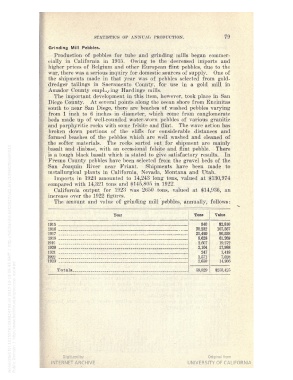
                        The amount    and value of grinding mill pebbles, annually, follows:


                                                Tear                              Tons     Value
                     1915                  .                                         340    $2,810
                     1916  . .                   _                      -          20.232   107,567
                     1917                     __  __                               21,450    90,538
                     1918                         _.                                8.628    61,268
                     191D                                                           2,607    19,272
                     1920                           ._                              2,104    17,988
                     1921                                                      .     247     1,418
                     1923 ______                                   .                1,571    14,986
                                                                                             7,628
                     1922
                                                                                    2,650
                         Totals                                                    59,829  $253,425

